304L Stainless Steel vs 304: Which Grade is Right for You?
When specifying stainless steel for fabrication, manufacturing, food processing, chemical processing, or construction projects, one of the most common questions is:
What is the difference between 304 and 304L stainless steel?
Both grades offer excellent corrosion resistance, durability, and versatility. In fact, they are so similar that many buyers assume they are interchangeable. However, the lower carbon content of 304L can significantly improve performance in welded applications and corrosive environments.
Understanding the differences between these two popular stainless steel grades can help ensure better long-term performance, lower maintenance requirements, and improved fabrication outcomes.
Quick Answer: 304 vs. 304L Stainless Steel
The primary difference between 304 and 304L stainless steel is carbon content. 304 stainless steel contains up to 0.08% carbon, while 304L contains a maximum of 0.03% carbon. The lower carbon content in 304L reduces the risk of carbide precipitation during welding, helping preserve corrosion resistance in welded areas and making it the preferred choice for heavily welded applications.
For most applications, both grades provide similar corrosion resistance and mechanical performance. The decision often comes down to welding requirements and long-term corrosion resistance around weld zones.
What Is 304L Stainless Steel?
304L stainless steel is a low-carbon version of standard 304 stainless steel. The "L" stands for Low Carbon, which means the material contains a maximum carbon content of 0.03%.
Reducing carbon content improves weldability and minimizes the risk of corrosion that can occur in heat-affected areas after welding. As a result, 304L is frequently specified for equipment, piping, and vessels that require extensive welding.
Common Applications for 304L Stainless Steel
- Process piping
- Pressure vessels
- Chemical processing equipment
- Pharmaceutical equipment
- Food processing systems
- Welded tanks and fabrications
What Is 304 Stainless Steel?
304 stainless steel is the most widely used austenitic stainless steel grade in the world. It is commonly referred to as the "workhorse" of stainless steel because of its excellent balance of corrosion resistance, formability, weldability, and cost.
Its composition typically contains:
- 18–20% chromium
- 8–10.5% nickel
This chemistry provides strong corrosion resistance and makes 304 suitable for a wide range of industrial and commercial applications.
Common Applications for 304 Stainless Steel
- Food processing equipment
- Kitchen equipment
- Architectural components
- Storage tanks
- Manufacturing equipment
- Industrial fabrication
304 vs. 304L Stainless Steel Comparison
| Property | 304 Stainless Steel | 304L Stainless Steel |
|---|---|---|
| Stainless Steel Family | Austenitic (300 Series) | Austenitic (300 Series) |
| Carbon Content | Up to 0.08% | 0.03% Maximum |
| Corrosion Resistance | Excellent | Excellent |
| Weldability | Very Good | Superior |
| Intergranular Corrosion Resistance | Good | Better |
| Strength | Slightly Higher | Sligtly Lower |
| Food Processing Applications | Excellent | Excellent |
| Chemical Processing Applications | Good | Preferred |
| Pressure Vessels & Piping | Good | Preferred |
Why Is 304L Better for Welding?
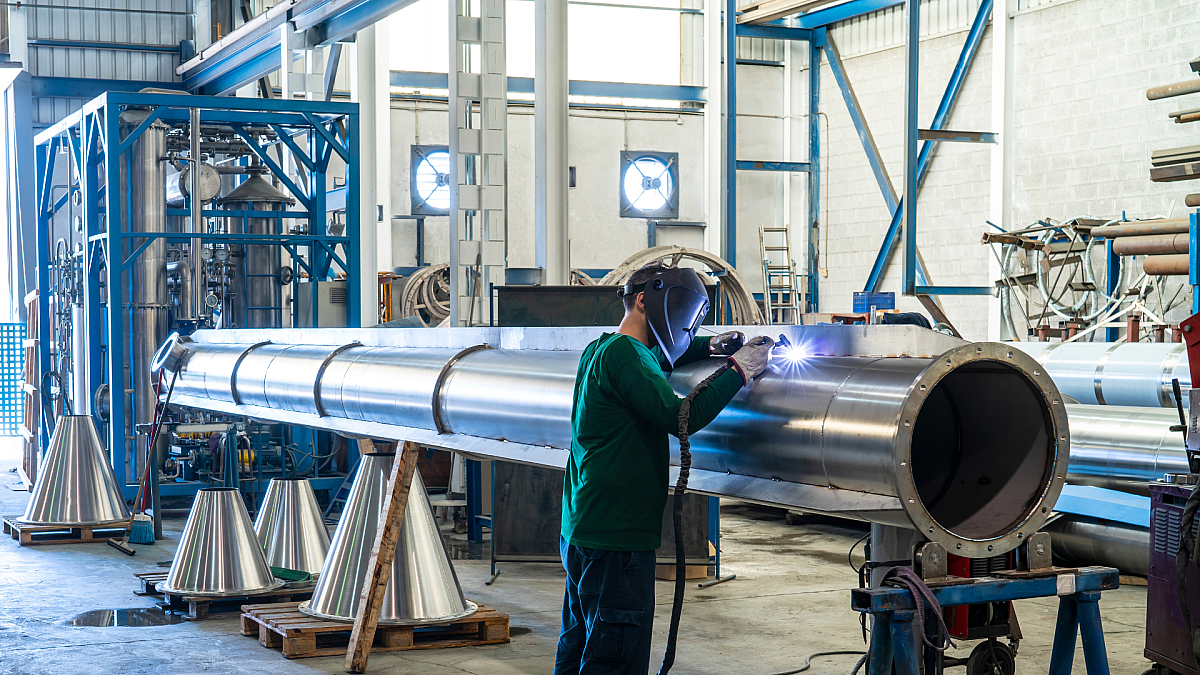
One of the biggest advantages of 304L stainless steel is its performance during and after welding.
When stainless steel is exposed to welding temperatures, chromium carbides can form along grain boundaries. This process, known as sensitization, can reduce corrosion resistance in the heat-affected zone surrounding the weld.
Because 304L contains less carbon:
- Carbide precipitation is minimized
- Welded areas retain better corrosion resistance
- Risk of intergranular corrosion is reduced
- Post-weld heat treatment is often unnecessary
For heavily welded fabrications, these benefits often make 304L the preferred choice.
Is 304L More Corrosion Resistant Than 304?
In most operating environments, 304 and 304L offer very similar corrosion resistance.
The primary performance advantage of 304L occurs after welding. The reduced carbon content helps maintain corrosion resistance around welds and limits the risk of corrosion-related issues in heat-affected areas.
For unwelded applications, corrosion performance between the two grades is often nearly identical.
When Should You Choose 304 Stainless Steel?
Choose 304 stainless steel when:
- Welding is limited or not required
- Maximum strength is desired
- General corrosion resistance is sufficient
- Cost efficiency is important
- The application involves standard fabrication
Common Uses for 304 Stainless Steel
- Food processing equipment
- Architectural trim
- Kitchen equipment
- Manufacturing components
- Storage tanks
When Should You Choose 304L Stainless Steel?
Choose 304L stainless steel when:
- Extensive welding is required
- Corrosion resistance around welds is important
- Pressure vessels are being fabricated
- Process piping is involved
- Chemical processing equipment is required
- Pharmaceutical applications are involved
Common Uses for 304L Stainless Steel
- Process piping
- Pressure vessels
- Chemical tanks
- Pharmaceutical systems
- Welded fabrication projects
Industries That Commonly Use 304 and 304L Stainless Steel
| Industry | Preferred Grade |
|---|---|
| Food Processing | 304 or 304L |
| Pharmaceutical Manufacturing | 304L |
| Chemical Processing | 304L |
| Manufacturing | 304 |
| Architecture | 304 |
| Process Piping | 304L |
| Industrial Fabrication | Both |
| Pressure Vessel Manufacturing | 304L |
Frequently Asked Questions About 304 and 304L Stainless Steel
Is 304L better than 304?
Neither grade is universally better. 304L is generally preferred for welded applications because its lower carbon content helps preserve corrosion resistance in heat-affected areas, while 304 may offer slightly higher strength.
Can 304L replace 304?
Yes. In many applications, 304L can be used in place of 304, particularly when welding is involved.
Why is 304L preferred for welding?
Its lower carbon content reduces carbide precipitation during welding and helps maintain corrosion resistance in welded areas.
Is 304L food-grade stainless steel?
Yes. 304L is commonly used in food processing and food-contact applications because it offers excellent corrosion resistance and cleanability.
What does the "L" in 304L mean?
The "L" stands for "Low Carbon." 304L contains significantly less carbon than standard 304 stainless steel.
Is 304L more expensive than 304?
Pricing varies based on market conditions and availability, but cost differences are often relatively small compared to the long-term benefits in welded applications.
Key Takeaways
- 304L is a low-carbon version of 304 stainless steel.
- The primary difference is carbon content.
- 304L offers improved weldability and reduced risk of intergranular corrosion.
- Both grades provide excellent corrosion resistance in most environments.
- 304 is commonly used in general fabrication and manufacturing.
- 304L is often preferred for process piping, pressure vessels, pharmaceutical equipment, and welded structures.